February 2, 2026
Most companies don’t need “more AI tools.” They need an operating system upgrade.
That’s the real shift happening in the mid-market right now. AI is moving from novelty to necessity, but the organizations seeing meaningful results aren’t the ones running the most pilots—they’re the ones building the infrastructure to make intelligence compound over time.
At VirtuousAI, we encourage all of our clients to follow a proven framework for turning AI into an operating capability. It’s a practical maturity model for BAIO (Business Automation, Intelligence & Outcomes) that improves decision-making, removes friction from execution, and ultimately drives autonomous operations.
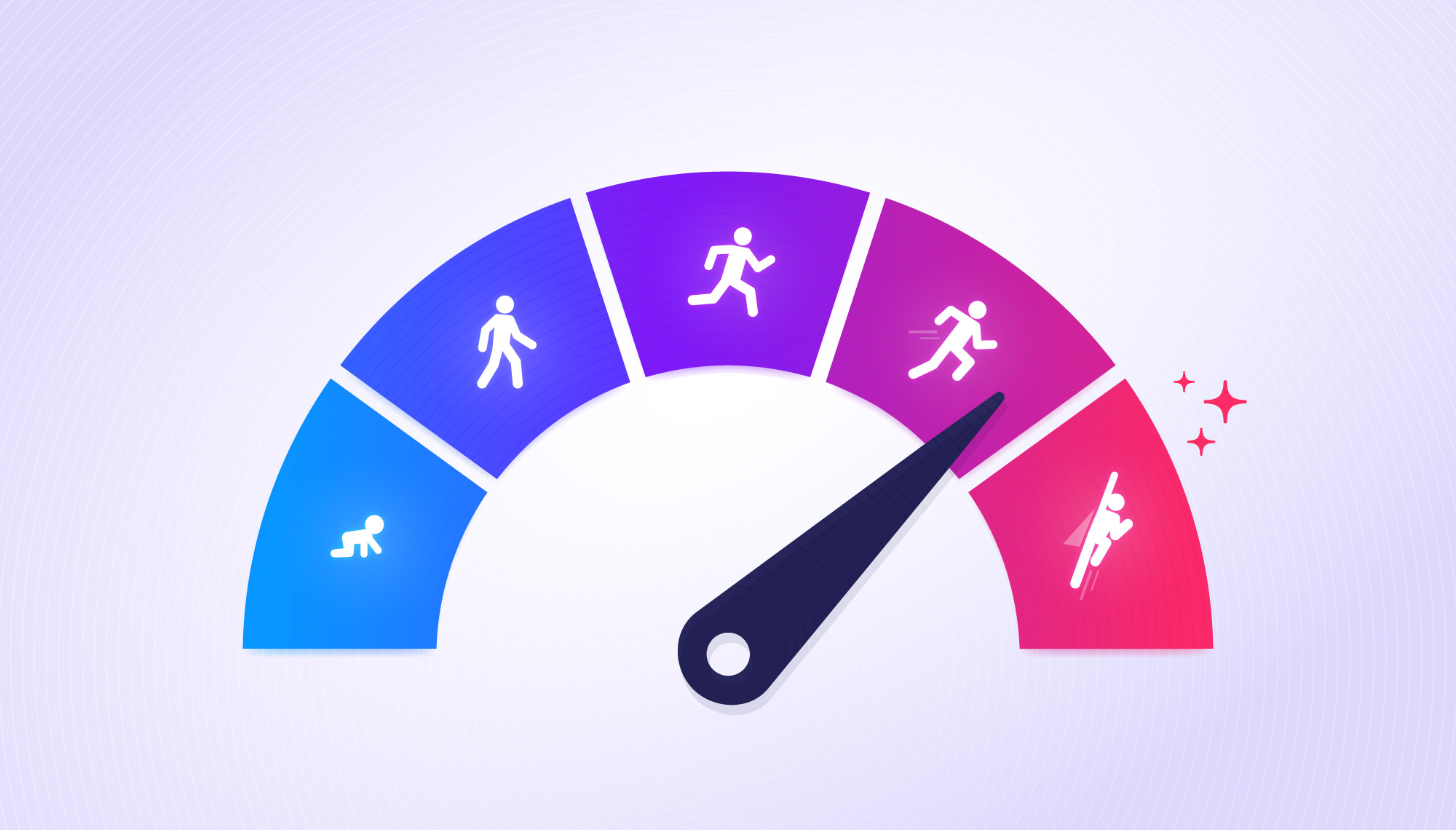
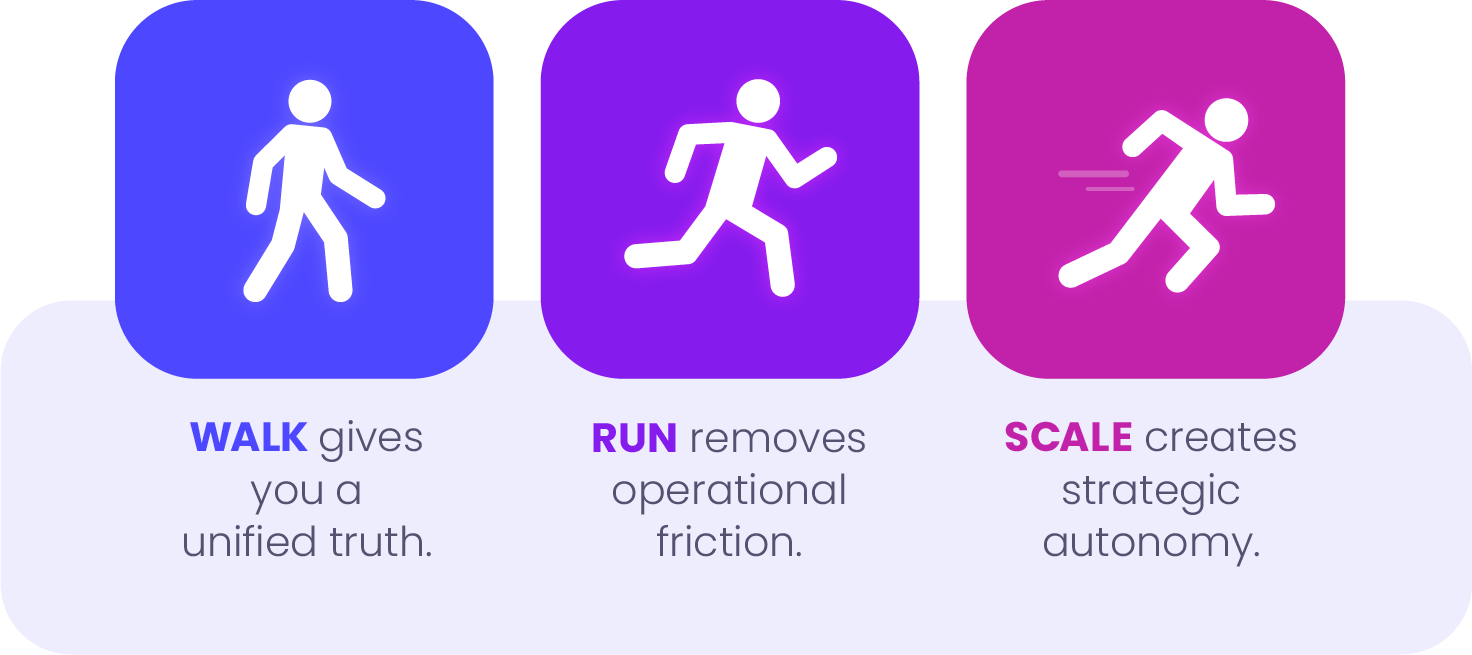
To make AI transformation achievable, we work with customers to deploy their BAIO through a simple sequence: Walk → Run → Scale. Each phase builds on the last. Each phase delivers real business value. And each phase brings the company closer to operating with speed, clarity, and control.
Strategic AI is not just a different kind of software. It’s a different operating model.
Tactical AI improves isolated tasks. It makes one function a little faster or cheaper. That’s helpful, but it doesn’t change how the business runs.
Strategic AI (like BAIO) is different. It creates a system where every outcome feeds back into the next decision. The company learns faster, acts faster, and gets smarter with every cycle. The value compounds.
Here’s how you build and scale a BAIO system—step by step.
Most mid-market companies already have the data they need to make better decisions. The problem is that the truth is fragmented.
Customer information lives in one place. Financial data lives in another. Operational activity lives somewhere else. Teams spend time reconciling numbers, debating definitions, and pulling reports instead of acting on insight. The result is a hidden tax on execution: decisions are slower, trust is lower, and leadership operates with uncertainty.
The Walk phase is designed to eliminate that tax by creating a unified, connected intelligence layer across the business.
BAIO connects the systems that run your company—tools like SQL databases, Salesforce, NetSuite, Snowflake, and more—into a semantic Knowledge Graph.
BAIO goes far beyond simple data integration. It maps the relationships between your most important entities (customers, assets, projects, vendors, teams, contracts, inventory, transactions, etc.) and ties them directly to the outcomes you care about.
Instead of disconnected dashboards, you get a shared operational reality. A corporate brain that understands how your business works in real time, not just what happened yesterday.
The outcome of the Walk phase is connected intelligence you can trust.
BAIO enables leaders to ask questions that used to require multiple reports, teams, and interpretations and get fast, consistent answers grounded in connected context. More importantly, it helps identify why things are happening, not just what is happening.
This is where the organization shifts from surface-level metrics to true root cause analysis. It becomes possible to see patterns across functions, understand drivers of performance, and spot risks early because the system can finally connect the dots.

Once the business has a connected intelligence layer, the next question becomes obvious: why are people still doing repetitive work that the system can do faster, cheaper, and more reliably?
Most organizations are filled with friction points that consume time and create delays. They aren’t strategic decisions—they’re operational busywork. They exist because the company lacks the connective tissue between insight and action.
The Run phase is where BAIO begins turning intelligence into execution.
In Walk, the system can see clearly. In Run, it starts acting.
BAIO moves from a read-only intelligence layer into a bi-directional execution layer. That means the platform doesn’t just analyze your environment, it can write back into the tools your teams already use, executing actions inside your existing workflows.
BAIO identifies repeatable decision patterns and operational friction points, such as invoice matching, lead routing, case triage, scheduling coordination, and other high-volume processes that slow the business down. Then it automates them safely, with human-in-the-loop control and governance.
This is how AI begins to deliver measurable ROI: not by producing more insight, but by removing the work that prevents your team from acting on it.
The output of the Run phase is a company that moves faster without adding headcount.
Workflows become automated. Data stays synchronized. Execution becomes consistent. Response times shrink from days to minutes. Leaders stop relying on manual handoffs and one-off heroics to keep the business moving.
Run is where you start to feel the operating model change. The business becomes less dependent on constant human coordination and more capable of executing intelligently at scale.
Automation is powerful, but automation alone isn’t strategy.
Most automation systems are rule-followers. They do what they’re told. They don’t adapt. They don’t pursue outcomes. They don’t optimize.
Scale is where BAIO goes beyond process automation and into something fundamentally different: agentic workflows that pursue goals continuously.
In the Scale phase, BAIO deploys AI agents that go beyond completing tasks to pursuing complex objectives.
These agents operate across functions, learn from results, and continuously adjust decisions to improve performance. They work 24/7, and they don’t stop at departmental boundaries.
Whether the goal is optimizing logistics, improving resource allocation, managing service delivery, adjusting pricing, or maximizing margin, the system is no longer executing isolated workflows. It’s coordinating decisions across the business to drive the outcomes leadership cares about most.
Scale is where AI becomes a competitive advantage, not a productivity upgrade.
The deliverable of the Scale phase is autonomy with accountability.
BAIO enables autonomous decisioning, where high-confidence actions are executed automatically, and leadership retains visibility and the ability to supervise exceptions. Over time, the system learns from every outcome and becomes more accurate, more efficient, and more aligned to strategy.
This is the point where the organization shifts from managing work to managing goals. From operating reactively to operating intelligently. From making decisions manually to running a system that improves decisions continuously.
Scale is the endgame: a business that runs smarter every day.
Most mid-market companies are stuck in experimentation because they’re trying to bolt AI onto fragmented systems and disconnected workflows. BAIO is designed to do the opposite: unify the business first, then automate execution, then scale into outcome-driven autonomy.
If you’re evaluating how to move beyond pilots and build AI that drives real business outcomes, we can help. Book a 1:1 AI Roadmap Workshop and we can start defining the right starting point and map a path for your business to scale.