Find out more about how BAIO works and get answers to your questions.
1. What is the Execution Gap, and why is it important for my business?
For a mid-market firm, the Execution Gap is not just an inefficiency; it's a direct barrier to growth and compounding ROI, making it a primary pitfall to avoid in AI deployment.
Prevents Measurable Outcomes
Action vs. Insight: Many AI tools only deliver insights or suggestions (like many copilots) but fail to take automatic action. The gap is where the value stops.
BAIO's Solution: The VirtuousAI BAIO platform is purpose-built to close this gap by automating the actions that are proven to drive cost reduction, customer lifetime value (LTV), and growth. Its core function is to execute, not just advise.
Wastes Limited Resources
Siloed Value: When the gap exists, companies buy AI tools that are not scalable or connectable to core business data, resulting in siloed value and early obsolescence.
Resource Constraint: For mid-market companies where resources are constrained, the platform must automatically execute actions since the company cannot afford large teams to constantly monitor and act on insights.
Hampers Corporate Strategy
Strategic Alignment: The BAIO platform is specifically designed to help mid-market companies close the Execution Gap, ensuring that AI initiatives accelerate core innovation and customer value.
Time-to-Action: By automating action, closing the Execution Gap dramatically improves the Time-to-Action benchmark, accelerating how quickly the organization moves from an insight to a fully executed outcome.
In short, closing the Execution Gap is essential because it is the difference between having an idea and achieving a measurable business win.
2. What is BAIO and how does it work?
BAIO stands for Business Automation, Intelligence, and Outcomes. It is VirtuousAI's proprietary strategic AI platform, designed to act as a "corporate brain" that unifies all your disparate data and intelligence into a complex knowledge graph. Its core function is to automate actions and drive measurable business results, helping mid-market companies close the critical "Execution Gap" between strategy and action.
How BAIO Functions: The Virtuous Cycle
Unlike limited point solutions, BAIO is a strategic foundation built for compounding ROI. It operates through the Virtuous Framework: 6 Steps for Strategic AI Implementation, which is based on "Right to Left Thinking"—visualizing the outcome first and then aligning assets and execution.
The Core Purpose: Action & Outcomes
Strategic Automation: BAIO moves beyond suggesting improvements to automatically executing actions across your systems.
Closing the Execution Gap: It is purpose-built to close the divide between high-level strategic goals and the ability to execute against them, translating strategy directly into tangible results.
Measurable Wins: The platform evolves small pilot projects into measurable business wins, from dynamic pricing to predictive demand planning.
The Process: Building the Corporate Brain
BAIO's success stems from its ability to unify and continuously refine intelligence.
Defines the Assets: It takes inventory of your people, first-party data, third-party data, and existing systems to drive the desired outcome.
Builds the Foundation: It customizes your ontological model (the strategic framework) around your Key Performance Indicators (KPIs). This maps how your data, decisions, and business processes relate.
Ingests and Trains: The system ingests your operational and market data, workflows, and company-specific intelligence. Because BAIO is a self-learning platform trained on your intelligence, it continuously refines its understanding through feedback loops.
Creates the Knowledge Graph: BAIO ingests and integrates multiple, disparate internal systems (ERP, CRM, sensor data) and external data into a complex knowledge graph.
The Result: Compounding Value
With each new use case, BAIO learns from more data and context, accelerating outcomes and driving exponential ROI. The more you use the BAIO system, the smarter and more valuable it gets.
3. How do we begin our AI journey?
The most proven way to begin an AI journey is by starting with strategy and outcomes, not just technology, to move quickly from experimental projects to measurable business wins. Most mid-market companies get stalled because they focus on the tool first, rather than the business impact. VirtuousAI flips this script using our proprietary AI Strategy Framework and 90-Day Launch Plan.
The Virtuous Framework: 6 Steps for Strategic AI Implementation
The core of our approach is "Right to Left Thinking," which means you visualize the outcome first and then align your assets and execution.
Visualize the Outcome: Identify the single, mission-critical business problem you want to solve, focusing on metrics like revenue lift, efficiency gains, or customer retention. Impact is the goal, not AI.
Define the Assets: Take inventory of your people, first-party data, and existing systems. BAIO helps unify these disparate assets into a single, connected model.
Build the Foundation: Customize your ontological model (the strategic framework) around your Key Performance Indicators (KPIs). This maps how your data, decisions, and processes relate.
Train the Platform: The BAIO system ingests your data and intelligence, and continuously refines its understanding through feedback loops for a custom-matched capability.
Apply the Use Case: Activate your AI models to make decisions or trigger automations that directly impact results, evolving pilot projects into measurable business wins.
Measure the Outcome: Track results against initial KPIs. Every iteration feeds back, sharpening accuracy and driving compounding ROI over time.
4. What kind of ROI should we expect on our AI investments, and when?
You should expect accelerated, compounding ROI achieved by driving tangible business outcomes quickly. Our 90-Day Launch Plan puts your highest-value use case into production swiftly, ensuring measurable value and a return on the initial investment sooner than with traditional, multi-year bespoke builds.
Three Key Areas: Define ROI in terms of growth acceleration, improved efficiency/reduced cost, and faster decision-making.
Tracking Returns: Tracking is based on movement in key business metrics (e.g., CAC, LTV, operational efficiency) directly impacted by the platform’s automated actions.
Compounding Value: The true ROI is compounding. Every new use case leverages the existing complex knowledge graph, scaling value without scaling cost.
5. Which AI use cases are delivering measurable value?
Strong returns are seen across functions, particularly where closing the "Execution Gap" drives significant value. Companies using BAIO have already demonstrated the ability to lower Customer Acquisition Cost (CAC) by 50%.
High-Value Use Cases
Marketing and Customer Focus: Predicting churn, identifying cross-sell opportunities, and triggering personalized outreach to increase Customer Lifetime Value (LTV).
Operations and Efficiency: Accelerating decision-making and automating complex processes by connecting disparate operational data via the BAIO knowledge graph.
6. How ready does our data need to be for AI?
While perfect data is rare, the required readiness is determined by the data needed for the initial high-value use case, minimizing the burden of a multi-year data overhaul. VirtuousAI's BAIO platform is designed to classify and integrate existing data, reducing manual harmonization.
Initial Use Case Focus: The focus is on selecting the data sources required for the first use case in the 90-Day Launch Plan.
BAIO's Capabilities: Proprietary technology within BAIO expertly classifies and integrates data from multiple sources to build a complex knowledge graph and apply contextual intelligence, making sense of existing structures.
Required Structure: You primarily need to provide access to your data sources so BAIO can build the ontological map and start the model training process.
7. How can mid-market companies integrate AI effectively?
The most effective strategy for mid-market companies is to invest in a strategic foundation platform, like BAIO, and focus on a single, high-value use case that can be rapidly deployed via a 90-Day Launch Plan to create immediate, measurable ROI.
Strategic Foundation First: Companies should avoid purchasing disconnected, single-function tools. Instead, invest in a strategic platform like BAIO that can ingest data from legacy systems and create a foundational "corporate brain" for infinite use cases.
Actionable Automation: For resource-constrained firms, the platform must not just provide insights but automatically take actions to execute, which BAIO's automation capability provides, closing the "Execution Gap".
8. Should we use built-in AI tools or build custom ones?
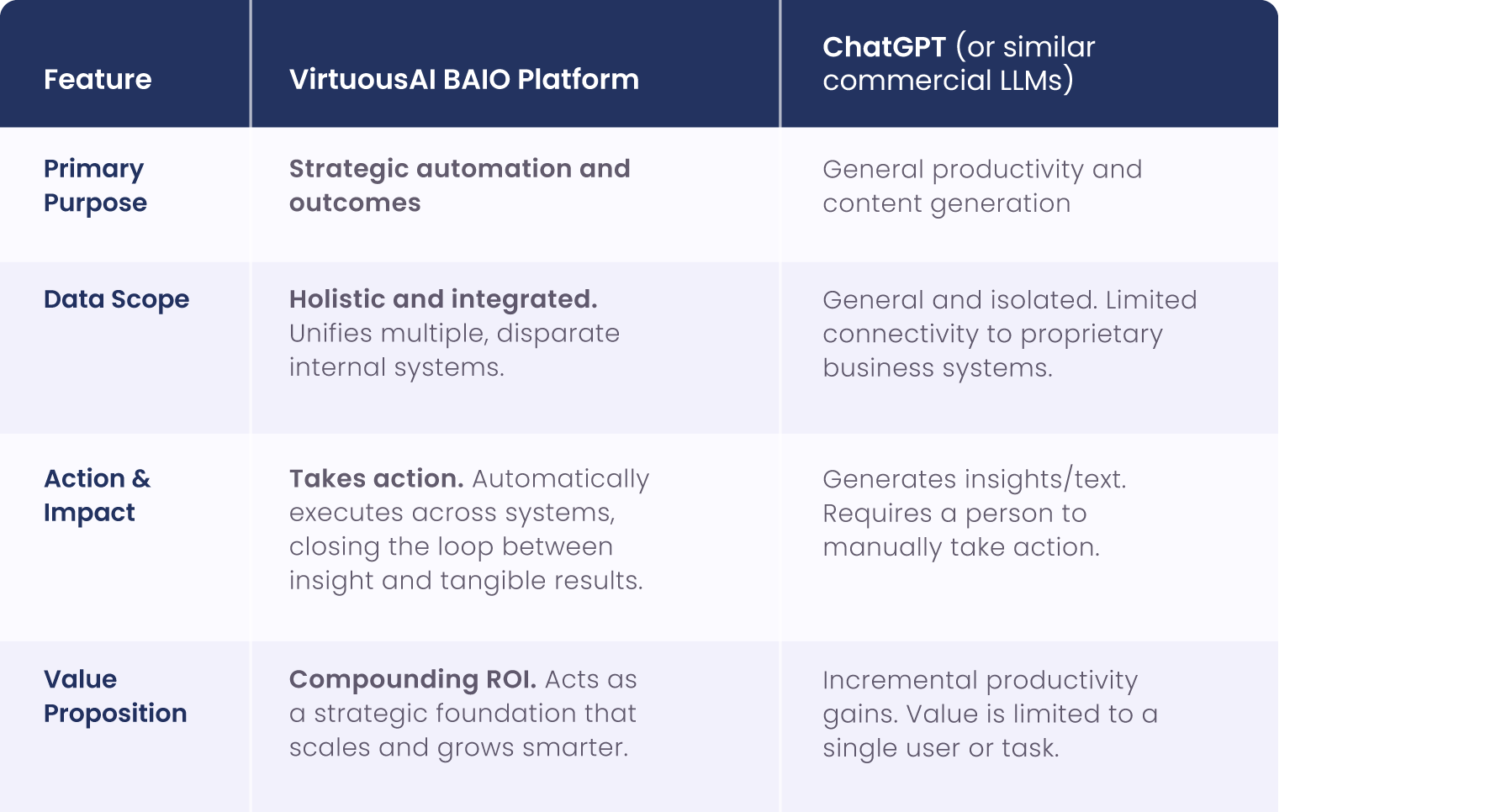
Built-in AI tools are limited point solutions focused on productivity within their specific software stack, offering limited connectivity to critical business systems. VirtuousAI's BAIO platform is the superior strategic third option, delivering the power of a custom solution at the cost and speed of buying an enterprise platform.
BAIO: The Strategic Third Option (A Comparison)
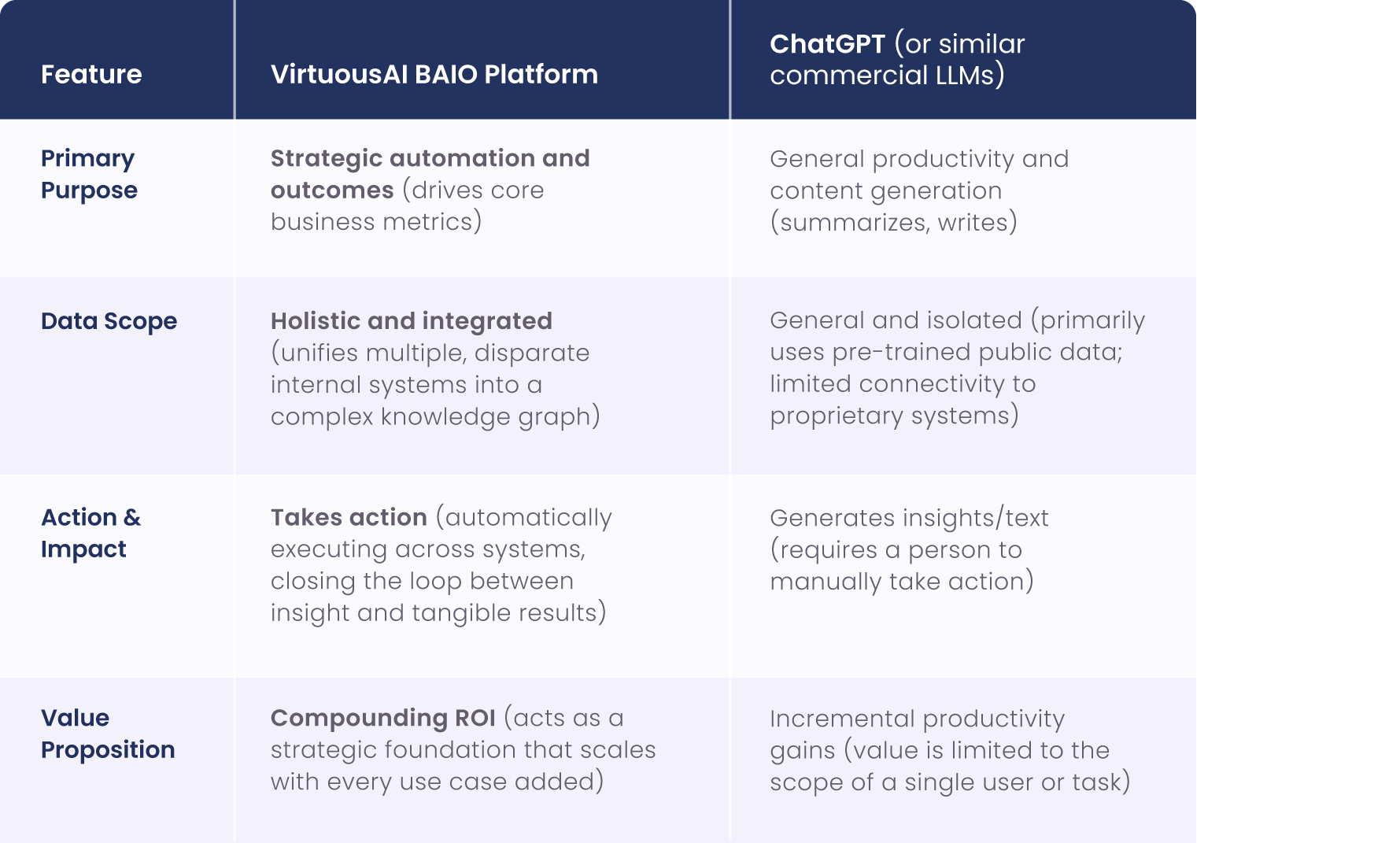
9. What's the difference between a BAIO platform and ChatGPT?
The fundamental difference is that ChatGPT is a large language model (LLM) focused on text generation and general knowledge for productivity, while BAIO (Business Automation, Intelligence, and Outcomes) is a strategic AI platform that integrates with core business data to automate actions and drive measurable business results.
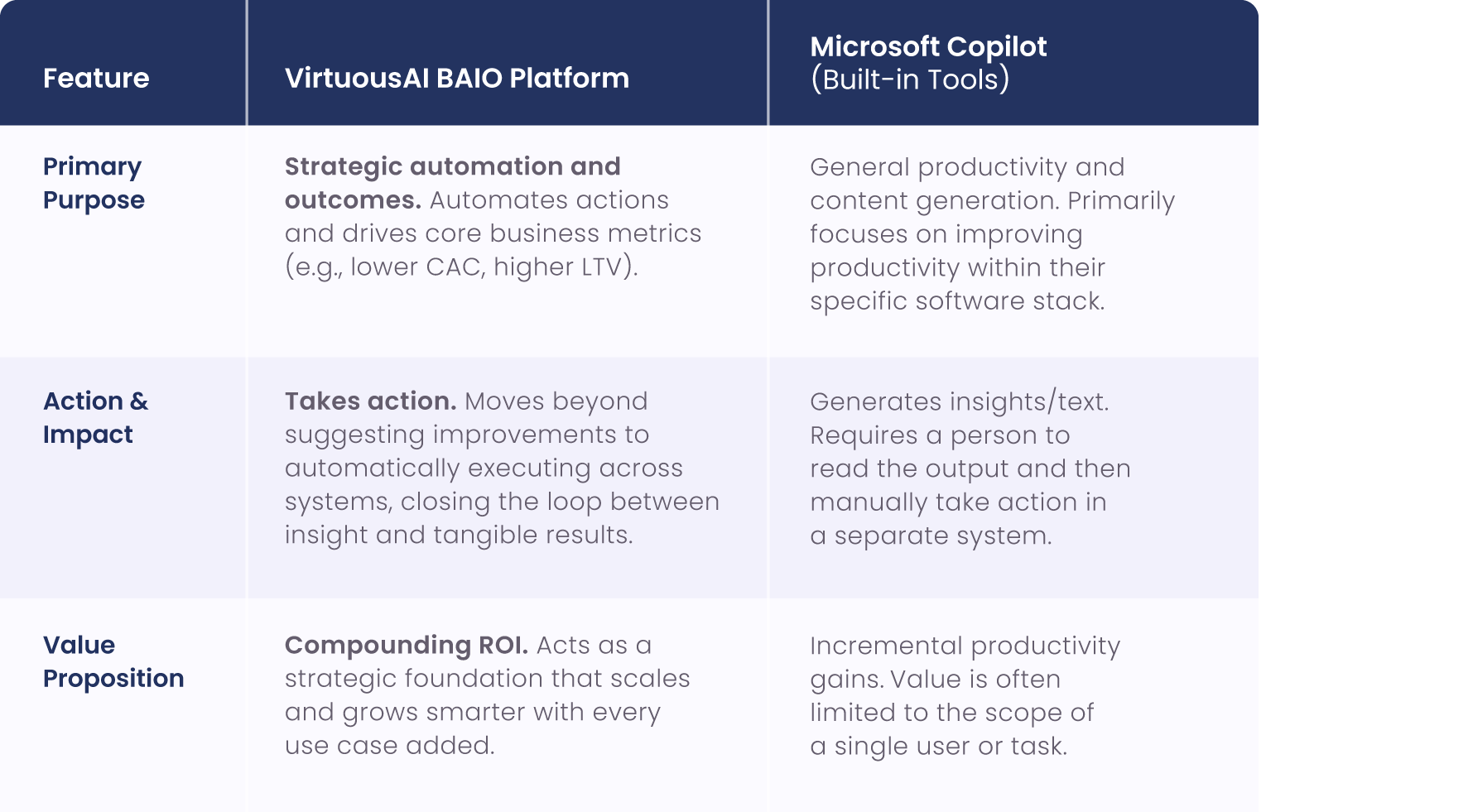
10. What's the difference between a BAIO platform and Microsoft Copilot?
The fundamental difference is that Microsoft Copilot (and similar built-in AI tools) are limited point solutions focused on improving productivity within a specific software stack. In contrast, BAIO (Business Automation, Intelligence, and Outcomes) is a strategic AI platform designed to unify all disparate internal data into a "corporate brain" to automatically take action, drive core business outcomes, and close the Execution Gap.
Purpose and Outcome
Data Scope and Strategic Depth
Holistic Integration: BAIO acts as a strategic foundation—your corporate brain. It ingests and integrates multiple, disparate internal systems (ERP, CRM, sensor data) and external data into a complex knowledge graph.
Limited Connectivity: Built-in AI tools provide limited or no connectivity to the vast majority of your internal business systems and critical external data. This means they can only offer high-level insights, not the transformative, strategic action needed to drive fundamental business outcomes.
Governance and Security
Robust Controls: BAIO safeguards sensitive data with robust in-model access controls. It offers private cloud or on-premise deployment options, giving maximum control over data environments for compliance.
General Boundaries: While the security of enterprise Copilot depends on the specific version, its data boundaries are less integrated into the core business architecture than BAIO's.
In short, while Copilot can help an employee write an email, BAIO helps your entire company achieve its strategic goals.
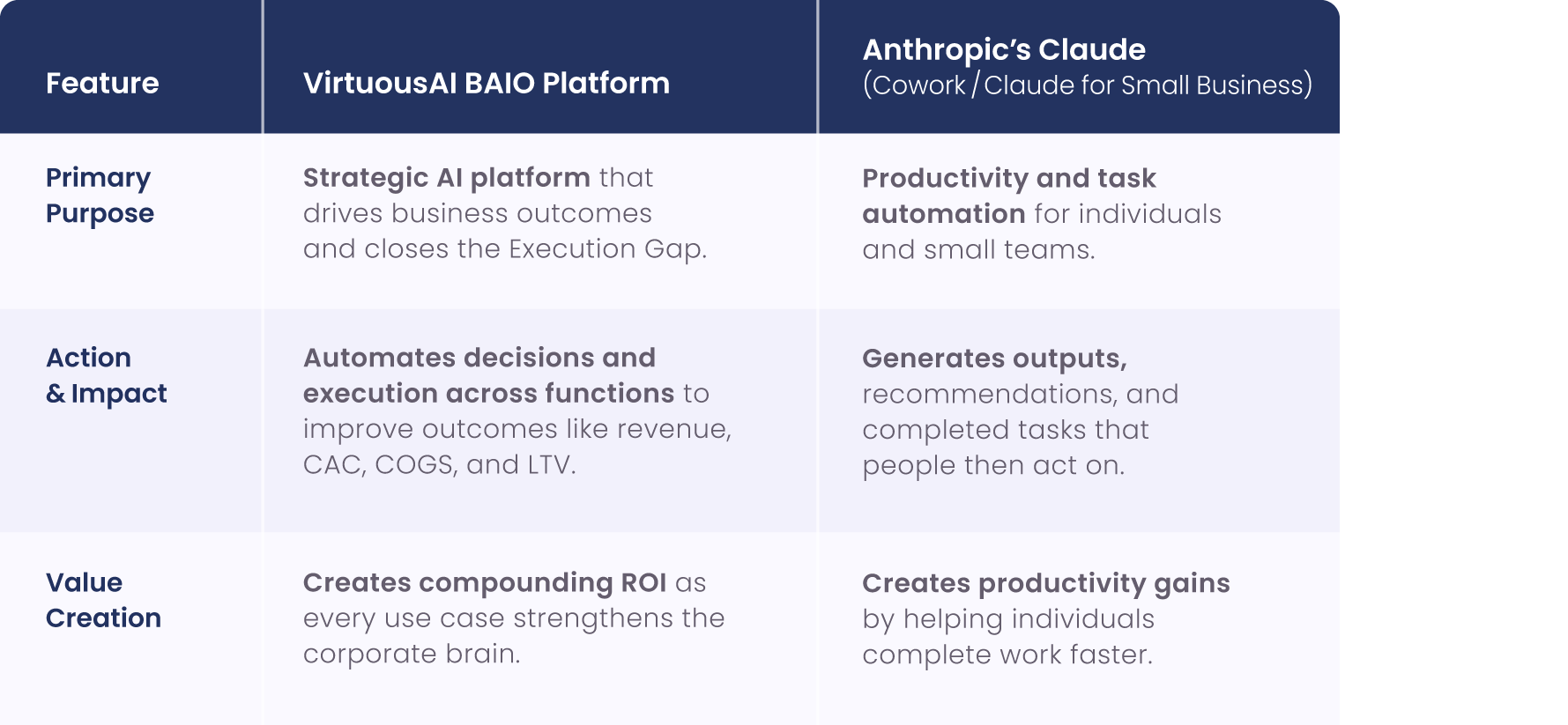
11. What’s the difference between BAIO and Claude Cowork or Claude for Small Business?
Claude is a powerful productivity tool designed to assist with documents, research, workflows, and everyday tasks. BAIO is a strategic AI platform that acts as a corporate brain, connecting your data, KPIs, systems, workflows, and decisions into one intelligent operating layer that drives measurable business outcomes.
Purpose and Outcome
Data Scope and Strategic Depth
Task Automation vs. Business Execution: Claude helps users generate outputs and improve productivity. BAIO connects intelligence across your organization to automate execution and close the Execution Gap.
Connected Intelligence vs. Connected Tools: Claude works through prompts, files, knowledge bases, and application connectors. BAIO builds a persistent intelligence layer around your business — learning your operating model, KPIs, processes, and goals.
Advice vs. Action: Claude helps teams move faster by providing recommendations and completing tasks. BAIO turns intelligence into action by automating workflows and optimizing outcomes like revenue growth, CAC, COGS, and LTV.
Productivity Gains vs. Compounding ROI: Claude creates efficiency by helping people work faster. BAIO creates compounding value — every use case strengthens your corporate brain and increases your ability to execute.
In short: Claude is designed to help people get more work done. BAIO is designed to help companies become AI-first businesses.
12. What pitfalls should we avoid in deploying AI?
Common failures stem from approaching AI as a pure technology project rather than a business strategy, leading to three main pitfalls:
Focusing on Insights, Not Actions: Investing in AI that only delivers insights or suggestions but fails to take automatic action and close the loop on value.
Buying Limited Point Solutions: Purchasing tools that are not scalable or connectable to core business data, resulting in siloed value and early obsolescence.
Ignoring the Execution Gap: Failing to translate strategy into action; BAIO’s design is specifically to help the mid-market close this gap and deliver measurable results.
13. How do we align AI with corporate strategy?
The right way to align AI is to view it as a foundational component of corporate strategy, not merely a technology investment. VirtuousAI's BAIO platform is purpose-built to serve this strategic function, ensuring AI initiatives support and accelerate core innovation goals and customer value.
Holistic View & Alignment: BAIO functions as your corporate brain, integrating data across the entire organization to drive corporate strategy and organizational alignment.
Closing the Execution Gap: The platform is specifically designed to help mid-market companies close the "Execution Gap," the divide between high-level goals and execution.
Enhanced Decision Making: By building a complex knowledge graph, BAIO allows leaders to explore strategic options based on real-time, explainable data, enabling faster and better decision-making.
14. What policies or guardrails should be in place to guide our AI strategy?
Setting clear expectations requires establishing organizational policies (Acceptable Use, Data Governance, Ethics, and Vendor Vetting) , supported by technology-driven guardrails. VirtuousAI's BAIO supports these by providing robust in-model access controls and deployment flexibility.
VirtuousAI's Built-in Safeguards
Robust In-Model Access Controls: BAIO is designed to safeguard sensitive data by ensuring only the right people have the right level of access to data and models.
Data Privacy and Deployment Flexibility: We prioritize data privacy by offering flexible deployment options, including private cloud or on-premise, giving maximum control over data environments.
Ethical Foundation: The platform is founded on a commitment to ethical AI, aiming for a more precise and explainable AI to support responsible deployment.
15. What criteria should we be using to choose an AI solution or partner?
The core criteria must move beyond features to focus on measurable ROI, strategic alignment, and long-term viability. The partner must commit to demonstrating movement on a KPI within a short, measurable timeframe, such as a 90-Day Launch Plan.
Focus on Compounding ROI: Choose vendors that deliver compounding ROI by scaling value with every use case, rather than requiring constant refreshing.
Strategic vs. Tool: Choose a partner who treats AI as a core business strategy.
Holistic Platform: The best partners provide a platform (like BAIO) that can unify and integrate multiple data sources into a complex knowledge graph.
Mid-Market Focus: Crucially, the vendor should be built for the mid-market, offering a complete AI foundation without requiring years of investment or large data science teams.
16. How do we upskill employees for AI?
The most effective approach is to integrate upskilling directly with the implementation of a strategic platform, ensuring AI literacy is relevant and immediately applicable. Training should focus on how the platform changes day-to-day work, empowering employees to execute better.
Focus on Engagement and Execution: Training should center on how employees interact with, audit, and leverage the automated processes that BAIO is designed to take.
Contextual Literacy: Build literacy by training employees on the explainability and insights provided by the platform, so they understand how the knowledge graph is built and how decisions are reached.
17. What is the expected impact of AI?
Strategic AI adoption, particularly with a foundational platform like BAIO from VirtuousAI, is designed to shift human roles toward higher-value work, focusing effort on strategy, customer relationships, and innovation. It fundamentally works to close the "Execution Gap" by automating low-value tasks.
Automation of Routine Tasks: The BAIO platform reduces administrative overhead and repetitive tasks, freeing up employee capacity.
Focus on Strategy and Innovation: By automating core processes, AI enables employees to dedicate more time to complex problem-solving and long-term innovation that aligns with corporate strategy.
Enhanced Decision-Making: The AI's knowledge graph provides a complete view of the business, enhancing the quality of human decision-making and focusing teams on high-impact strategic options.
18. How do we ensure privacy and data collection with AI?
Ensuring privacy and data protection is foundational to VirtuousAI, primarily by leveraging technology with built-in security features, robust in-model access controls, and flexible deployment options to maintain data sovereignty.
In-Model Access Controls: BAIO safeguards sensitive data with robust in-model access controls to ensure only authorized users access the right data at the right time, enforcing compliance and privacy.
Deployment Flexibility: We support the highest data privacy standards by offering private cloud or on-premise deployment options, allowing companies to maintain sovereign control over their data environments.
Data Minimization: BAIO integrates and uses data within a governed environment, reducing the need to copy sensitive data into third-party, general-purpose tools.
19. What's the difference between VirtuousAI and commercial AI solutions like ChatGPT Enterprise in terms of governance, data handling, and ethical guardrails?
The key difference is that VirtuousAI is a strategic AI foundation for the mid-market built with inherent ethical standards, focusing on precision, explainability, and the highest security controls over proprietary data, unlike commercial LLMs focused on general productivity.
Governance & Ethics: VirtuousAI is committed to ethical AI, aiming for a more precise and explainable system that operates with high ethical standards and lower compute time.
Data Handling: BAIO integrates all your internal and third-party data via a complex knowledge graph. Sensitive data is secured using robust in-model access controls and flexible deployment options like private cloud or on-premise.