October 21, 2026

Ninety-seven percent of executives say AI has personally made them more productive. That same survey shows only 29% of their organizations are seeing meaningful ROI from it. Fifty-four percent say AI adoption is tearing their company apart.
Same technology. Same investment. Completely different outcomes — depending on whether you're measuring the person or the organization.
That gap is not a technology problem. It's a structural one. And if you're leading a mid-market company right now, it deserves your full attention — because the Silo Tax compounds.
Here's what's actually happening inside most mid-market companies in 2026.
Your CFO is using AI to compress the month-end close. Your VP of Sales is using it to draft better call prep. Your marketing team is generating copy at three times the speed. Every one of them is individually faster, sharper, more confident. On paper, AI is working.
But the CFO's faster close is still built on numbers she manually pulled from three systems. The VP of Sales is pitching a margin story that finance hasn't validated. Marketing is generating demand for a product that ops has already flagged as over-allocated. Everyone is moving faster — in slightly different directions, on slightly different versions of the truth.
That's the Silo Tax. Not a line on your P&L. Not a failed initiative you can point to. It's the invisible cost of a company where every team is smarter in isolation and less coordinated as a whole.
And the painful irony: the more aggressively your teams adopt AI tools, the more efficiently they can entrench their own silos.
Seventy-nine percent of executives in the Writer survey said AI applications at their company are being created in silos. Fifty-five percent described it as a "chaotic free-for-all." These leaders aren't failing at AI. They're succeeding at the wrong thing.
Read more about how The Silo Tax is killing profitability in this blog post.
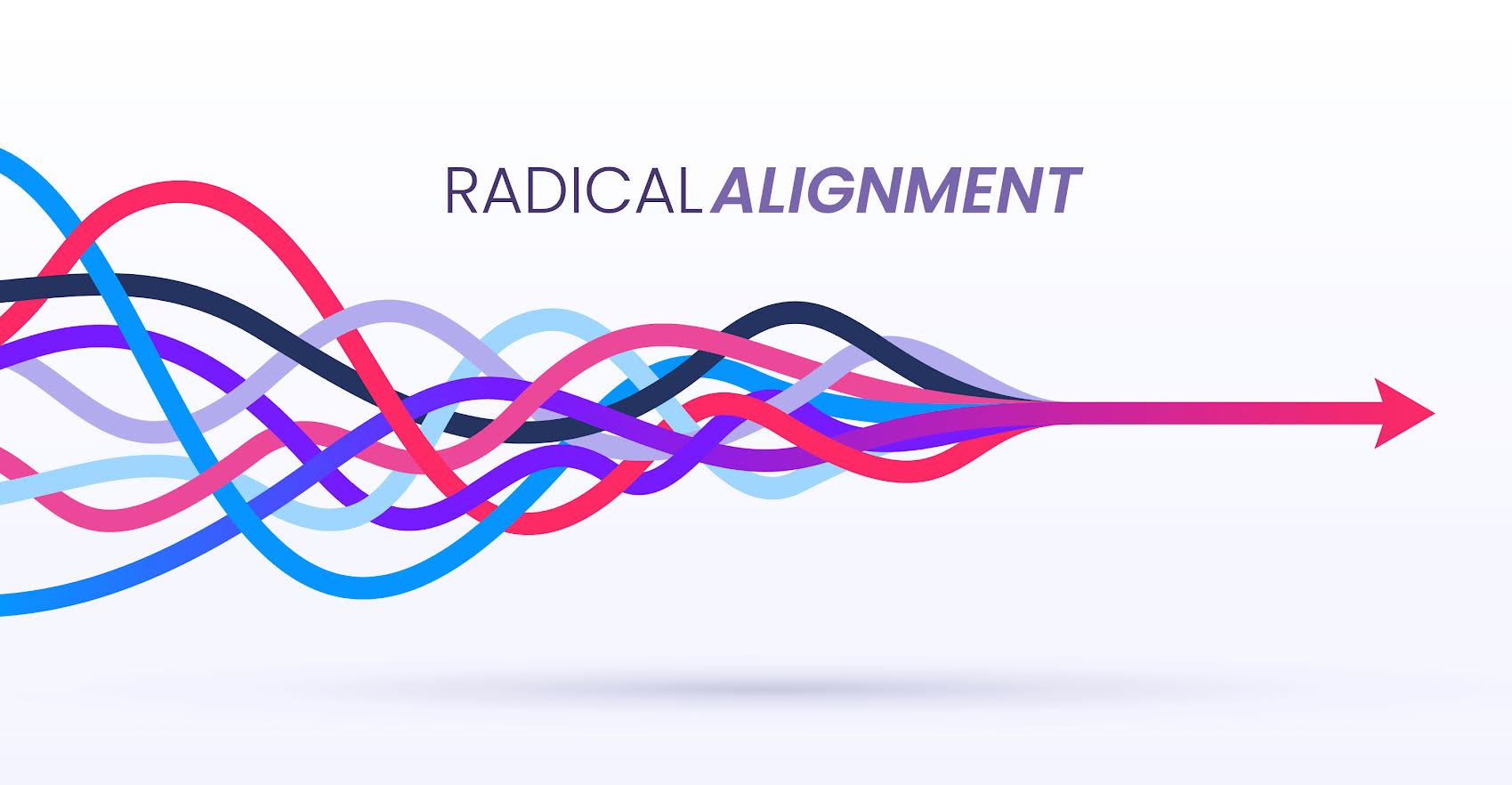
The shift isn't about slowing down individual AI adoption. It's about creating the conditions where those individual wins add up — where they compound at the organizational level instead of canceling each other out.
That operating state has a name: Radical Alignment. Vision flows down at full fidelity. Reality comes back up at full speed. Every function draws from the same intelligence, at the same time. Not because people are communicating better, but because there is one source of truth — and it's operational, not aspirational.
This is not a coordination problem you solve with better meetings or a new Slack channel. It's a structural problem. The organization doesn't have a brain. It has a collection of capable departments — each with their own data, their own AI tools, their own version of what's true — and a CEO in the middle translating between them.
That translation layer is what the Corporate Brain eliminates. Not by replacing your existing systems, but by creating a unified operating environment where the intelligence those systems generate actually flows to the people who need it, when they need it, in the context of everything else that's happening.
That is what BAIO is. Not a tool on top of what you already have. The environment everything runs inside.
When Crow Holdings scaled to 450 properties, they hit the same wall most mid-market companies hit — just with higher stakes. Manual data consolidation across dozens of property management systems. Institutional knowledge locked in five executives' heads. Portfolio-level signals arriving after the window to act had already closed.
They weren't failing. The business was growing. But the intelligence infrastructure that built the company couldn't scale with it.
VirtuousAI brought BAIO in — and the result wasn't a dashboard or a better report. It was a rewiring of how intelligence flows across the entire organization. The outcome: 1,000+ hours per month recaptured across the organization. $300K in CIO-level productivity unlocked annually. Not projections. Not efficiency estimates. Capacity that had been buried in operational overhead, now available for the strategic work that actually requires it.
And here's what matters most: those numbers aren't extraordinary. They're what happens when you solve for misalignment at the organizational level instead of patching individual workflows.
When Mugsy CEO Leo Tropeano found himself in the middle of a stalled Black Friday — with Cyber Monday less than 24 hours away — he didn't need another AI tool. He needed a Corporate Brain in the room. BAIO surfaced the right SKU, the right discount depth, competitive benchmarks, and launch timing. In real time. From his own business data. The pivot worked. And when it was over, BAIO delivered a full post-mortem — revenue arch before and after, incremental margin unlocked, decision grade — in seven minutes. "Someone smarter than me," Leo said, "would have taken a day."
That's what Radical Alignment looks like in practice. Not efficiency. Compounding advantage.
You've probably tried AI. Your teams are using it. Some of it is working. But if you're honest about the results — not the individual wins, the organizational results — something isn't adding up.
That gap is the Silo Tax. And it doesn't stay where it is. Every quarter your teams compound their individual AI gains in isolation, the structural misalignment compounds too. The cost of waiting isn't inertia. It's drift — faster drift, because the tools are moving faster.
The companies that close that gap first don't just get more efficient. They get a structural advantage that widens every quarter over the organizations still manually aggregating data when the next critical decision window opens.
The question isn't whether AI is working for your people. It clearly is.
The question is: what is it costing you that it isn't working for your company?
Book a strategy session with VirtuousAI CEO Chris Happ, and unlock a FREE 7-day test drive of BAIO. In 30 minutes, you'll see exactly what a corporate brain would look like applied to your business — where the Silo Tax is hitting hardest, and what becomes possible the day you close it. Then you'll have a week to test drive it for yourself. On your business. With your KPIs. Your biggest challenges. And your customers.
The organizations that move first on this don't look back. The ones that wait are still explaining to their boards why their AI spend isn't showing up on the P&L.